It took a second class period sitting in the room to hear
the stealthy ticking of the clock. (Perhaps it was because first period doesn’t
test very well -- some of them seem skittish about silence.)
But during second period, for the first time pretty much all
year, I noticed its steady, rhythmic breathing (perhaps that’s redundant).
It wasn’t until fourth period that it became incessant --
perceptually salient now that it has entered my awareness, a “face” from which I
am unable to turn (for it enters my ears at all angles).
It “watches” over me like a silent sentinel, its hands “pointing”
the ways to go for the students (if only they were paying attention to it).
I wonder if that sound will ever truly get out of my head,
now that I have become aware of it -- similar to how an idea never truly leaves
you, once your mind has processed it...
“The mind, once stretched by a new idea, never returns to
its original dimensions.” ~ Ralph Waldo Emerson
Most
people who go to church either categorize themselves as Catholic or Protestant
-- or a Protestant (non)-denomination.
For
me, when I became a follower of Christ in college, the only experience I really
had was when my family had gone to an Assembly of God church when I was in
ninth grade. So I pretty much became a Protestant by default.
My
steadfast Protestantism grew as I learned things about Catholicism that I didn’t
agree with, such as Scripture and
tradition being sufficient for spiritual authority (see Mark 7:8), or transubstantiation.
As I grew
in my knowledge about different beliefs within Protestantism, I identified
myself more particularly: at first it was Assembly of God, then
non-denominational, then Adventist. At the moment, I currently go to a Foursquare
church (even though I hold to certain beliefs that conflict with the official doctrines of that denomination).
But I no
longer identify myself by any of these labels.
I’ve
known for a while that I’m a spiritual “mutt” -- my particular belief system is
a hodgepodge of several schools of thought (the strongest one -- and the only
one I truly identify myself as being as evidenced by the title of my blog -- is
Ransomed Heart).
Then --
through one of the members of Ransomed Heart -- I learned about a book on
contemplative spirituality called Open Mind, Open Heart.
Contemplative
spirituality is something I’ve kinda identified myself with since taking the You’ve Got Style quiz
from North Point Community Church. Based on the quiz -- which is derived from
the book Sacred
Pathways -- contemplatives “draw near to God through personal adoration and
heartfelt devotion” (I also scored high on “ascetic” and “intellectual,” if you
really want to know).
So I was
curious to learn more about what it meant to really be contemplative --
especially since other contemplative-ish sources (such as Dan Millman’s book, Way
of the Peaceful Warrior) were also life-changing to me.
But I was
also hesitant.
You see,
the book is written by Thomas Keating, a Cistercian monk of St. Benedict’s
Monastery.
Catholic.
But
the book was recommended from someone that has helped shape how I view the
world (in a positive way), and so I went ahead and read it.
*Insert
breath of fresh air.*
This
was, at the time, the only Catholic book that I had. There were a couple Catholic
references in it that I disregarded (“eat the meat and throw away the bones,”
as the saying goes), but on the whole, the book resonated with me profoundly.
I recall
one time going rock climbing with a friend and his kids, which involved driving
down by the river,* then walking along a trail in order to get to the (outdoor)
wall. Part of me was freaking out about being away from “civilization” unexpectedly:
no computers, no bathrooms, etc. (This is different when you go camping since
you plan the trip out; this particular excursion caught me off-guard.)
* No,
we didn’t go in a van, and no, he didn’t have any government cheese.
Once I
was out there, however, it was great and a welcome escape from the technology-infused
environment I so often find myself in.
Of
course, the concept of the physical realm being important to masculinity intrigued me, and while I was looking at Shop Class as Soul Craft on Amazon, I saw
that it was “paired” with a similar book called Zen
and the Art of Motorcycle Maintenance.
Consequently,
both went on my Amazon Wish List.
So when
I’m in Barnes & Noble last week, imagine my elation when I see Zen and the Art of Motorcycle Maintenance
on one of the tables!
But Jesus
is cunning and promptly pulled a bait-and-switch on me, because I then noticed
the book next to it, which was The
Jesuit Guide to (Almost) Everything.
Jesuits
are Catholic, so they have been somewhat off-limits for me, but they also have
a reputation for being intellectually fierce (remember, one of my “pathways” is
intellectual). As Pat Conroy tells of
his experience at a Jesuit high school, Gonzaga, in My Losing
Season,
Throughout
my nun-spooked, Catholic school life, I had heard and digested the urban legend
of the Jesuits, the rottweilers of a Catholic boy’s education. The order had a
reputation for intellectual ferocity... They were a warrior caste of the
intellect, famous for the rigor of both their training and their teaching.
Founded by St. Ingatius Loyola as militant advocates of the Pope, the Jesuits
have always prided themselves on their fierce reputations as cunning foot
soldiers of the far-ranging, free-thinking Catholic mind. Astuteness, acumen,
and razor-sharp perceptions were virtues in the high precincts of the Jesuit
world...
A
dark sensuality and a celebration of the masculine virtues as tribal rites inhabited
each corner and room of that beleaguered, ghetto-encircled school. Everything
was tough about Gonzaga, including its neighbors. The Jesuits possessed a
genius at making learning itself seem like a martial art... At Gonzaga, I always
felt as if I should be wearing a coat of armor instead of a coat and tie.
Curious as a cat,
I picked up the Guide and randomly opened to a page:
Sadness
is something else that some people feel reluctant to share with God. Someone
once told me of the experience of going to a movie with a close friend. Because
the subject material intersected with his life, he began to sob at the end of
the movie and was embarrassed. Later on, as the two sat together in a car in
the parking lot, his friend sat silently and simply let him cry.
His
friend wasn’t the only one showing love. The person weeping allowed another to
enter into his life, giving the gift of intimacy. Can you share with God the
intimate gift of your true self, your true emotions, even when you are
grieving?
Hook.
Line. And sinker.
Not
just because of this one passage -- for I could’ve snapped a pic of the page
with my phone -- but because the passage reveals an underlying belief on how to approach God -- a perspective
that rang true with my heart.
LABELS
Back
to my “not being a Protestant.”
I don’t
consider myself a Protestant any more.
No, I’m
not becoming Catholic.
No, it’s
not just because I bought a second
Catholic book.
It’s
because buying the Jesuit book made me realize that there are others out there
who have walked this journey of faith -- specifically the particular paths that
I want to travel -- even though they may come from belief systems I may not
whole-heartedly agree with.
And that,
when I label myself as something other than simply a follower of Christ, I unintentionally
“box” myself -- and God -- into only being able to operate or relate in a
certain way.
So I encourage you, reader -- especially those of you who were raised in church -- examine what you believe based on your experiences with God and your reading of Scripture and other sources. Don't just passively accept what your church or your family believes. In the end, your beliefs are the only ones that matter, anyway (Ezekiel 18:20).
I'll be honest: the only reason I'm clean-shaven on my face is because I hate having facial hair more.
I hate shaving -- or, at least having to shave -- but I hate having facial hair more.
I
suppose that it doesn't help that I don't have a lot of facial hair
(it's not really thick). Apparently it's so sparse that, according to a good friend who
has used make-up techniques to help other guys' beards seem more full, I "don't even have enough to work with," even if I wanted to grow it out.
One day, while
expressing my frustration about shaving and looking for a long-term
solution for my loathing of this grooming chore, a buddy of mine -- who was completely oblivious to my dilemma -- sent
me the website Dollar Shave Club:
I
had previously been using my electric razor every 2 days or so (I can
get away without shaving for a day and no one really notices, so of
course I don't shave every day).
But I was looking
for something different -- not really sure what -- and here's this
Whisper (Sacred Romance reference) calling me in the direction to
transition to a razor and shaving cream.
Pffff.
Dismissal of the idea with a casual wave of the hand.
No
way I'm going in that direction; it's more inconvenient than using my
electric razor, and what I'm looking for -- now that I think about it --
is something easier.
Never mind the fact that "easy doesn't enter into adult life" (The Weatherman). So I cut my hair last week and you would never guess what happened. No really; go ahead and see if you can guess what happened. I'll give you a hint: I always make sure to shave when I cut my hair. Can't figure it out? Yeah, I wouldn't have guessed, either. My electric razor broke. Oh, no. What actually happened is that the "on" button you're supposed to push in to make it slide up and turn on got "stuck" in the "3" position (the furthest spot up that activates the secondary trimmer) so that I couldn't turn it off. I finished using it the best I could, but then I had to let it sit on the sink -- as if it were in time-out because it had done something wrong (as opposed to user-error for not following the Wild Goose) -- and let the battery run down. It was like a kid crying because they were bad and had to sit in the corner or go to their room: it was an untenable situation and I was helpless to intervene and make things right. My electric shaver is out of commission; he threw a pitch and pulled his shoulder. "Give me the righty!" The coach calls to the bullpen for his relief pitcher.. Enter the good ol' low-tech Gillette shaving cream and Mach 3 sampler that I happened to have and kept stored in a box with my excess toiletries. I've had to use it for the last week or so, and of course, as with any change, there's a sense of loss for what used to be the status quo because -- let's face it -- we get used to things how they are and we're averse to change (for the most part). But today I realized something. First, I wasn't ever taught how to shave. I imagine that many men today aren't. My dad kept a trimmed beard and used an electric on his neck, so I never learned how to shave from him. Then you get to factor in the reality of me not having a lot of facial hair (I was a late bloomer and didn't really have to shave until college), and it's no surprise that I never learned how to shave. I've had an electric razor pretty much all my life. I bought a really nice Braun during college, and it lasted for almost a decade (until it broke last week). You ever have one of those times where you feel God prompting you on something, and then you're like, "No way"?
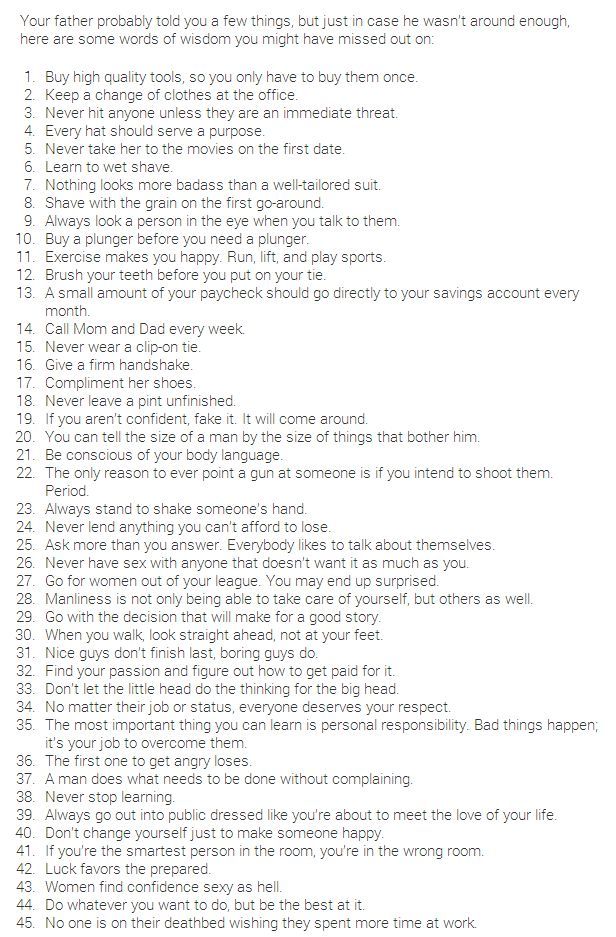
This was one of those times. And then I was kicked out of the proverbial eagle's nest and forced to (learn how to) fly. And with any change that one is forced (against their will) to accept, I pouted. At first. But then I realized that it's not as bad as I figured. I'm (sort-of voluntarily) shaving (what I would now call "shaving" as opposed to just "cutting facial hair") for the first time in my life. And I'm 30. And then I had some questions. Why are you supposed to shave with the grain and not against it? Wouldn't that make more sense? So I did what pretty much anyone does when they have a question: I went to the most all-knowing source I knew of. That's right. I Googled it lol. And I came across something that dealt with wet shaving. I saw this term, wet shaving, on an info graphic on one of my favorite websites, I Waste So Much Time, last week as well (it's #6, although a lot of the info on there is good stuff):
So I started looking into that. And I stumbled upon this post from Today.com about shaving. I learned more in 10 minutes than I had in 30 years. Because Someone was fathering me through an area of my life where I had previously been a (very unhappy) orphan -- prompting me to go in a direction that would bring me more life. Yes, I was pushed into this, "kicking and screaming" (to quote Tyler Durden), but I'm realizing that the grass on this side of the fence is a lot greener than I thought. (Of course it is, when your Father goes before you to prepare it for you, Deuteronomy 31:8.) Just today, I ended up cutting my hair and shaving after my shower (usually it's hair, shave, then shower). For part of the wet shave, your facial hair has to soak up the water, which causes the hair to soften and makes it easier to cut instead of practically ripping it out of your face when it's dry. I had to rinse my face afterward since I had already showered (the shower would normally rinse the excess shaving cream off for me). Yes, it was inconvenient. Yes, it took up more of my time. But I felt so much better after a haircut and a good shave (my "whiskers" had grown out for several days). And this came to mind:
I would add "grooming" to the list of eating and exercising; you feel better about yourself when you take care of yourself and show yourself some love. You end up taking more pride about who you are (which explains why I always feel better about myself after I cut my hair). And that's what really hit me today: the "inconvenience" of having to slow down and pay attention to what I was doing -- instead of just running an electric razor all over my face -- forced me to be more present (Peaceful Warrior reference) to, and take more care in, what I was doing. Living on autopilot is somewhat of a habit of mine, and so anything that breaks this up is a "welcome inconvenience," if you will.
That, and I realized that wet shaving is the men's grooming equivalent of operating a straight-drive: it's just more masculine, and it's more unplugged from the Matrix of this world's artificially created realities (more on that another time). Will I sign up for Dollar Shave Club? I don't know. In the short term, probably. In the long term, getting a badger-hair brush and a real double-edged safety razor -- or even a straight razor -- may be somewhere down the road, but I have yet to come upon that part of the path with the One who is leading and fathering me in these unfinished places in my life...